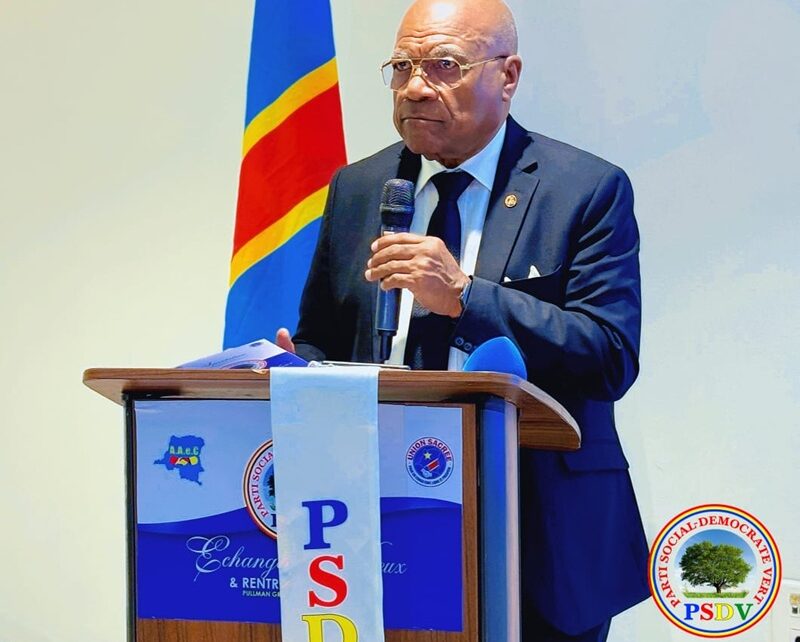
The demand for the withdrawal of Rwandan troops from the Democratic Republic of the Congo has drawn contrasting reactions from international figures, prompting a response from former deputy prime minister and foreign affairs minister, now national deputy Léonard She Okitundu, along with his party, the Green Social Democratic Party (PSDV). At the centre of their attention are statements by US Secretary of State Marco Rubio and Belgian Foreign Minister Maxime Prévot regarding the removal of Rwandan forces from occupied areas in eastern DRC.
In a declaration dated 7 June 2026, She Okitundu and his party described these international positions as a significant step forward in the search for a lasting solution to the security crisis affecting the country’s east. They noted that growing global interest in the situation in North Kivu and South Kivu provinces reflects a heightened awareness of the security and humanitarian challenges faced by Congolese communities. The PSDV and its leader view this diplomatic mobilisation as a potential accelerator of peace efforts in a region scarred by armed violence and mass displacement.
However, while the former foreign minister and his party particularly applaud statements by US Secretary of State Marco Rubio—who reportedly set a deadline for the effective departure of Rwandan troops from Congolese soil, seeing this as a strong signal of Washington’s commitment to the DRC’s sovereignty and regional stability—they sharply criticise the position taken by Belgian Foreign Minister Maxime Prévot. Prévot had raised the need for simultaneous action: the withdrawal of Rwandan troops alongside the neutralisation of the FDLR.
For She Okitundu and the PSDV, this approach risks providing a pretext for delaying the fulfilment of obligations imposed on Rwanda. They recall that UN Security Council Resolution 2773 demands an immediate and unconditional withdrawal of Rwandan troops from Congolese territory. In their view, that resolution remains the primary legal and diplomatic framework for achieving a sustainable de-escalation of tensions in eastern DRC.
Given the persistent insecurity in several areas affected by armed clashes, the PSDV and its leader not only call on national and international actors to maintain diplomatic pressure to ensure respect for international commitments and foster the return of peace, but also reaffirm their dedication to defending the DRC’s territorial integrity. They advocate for a solution grounded in international law, regional cooperation, and adherence to United Nations resolutions.