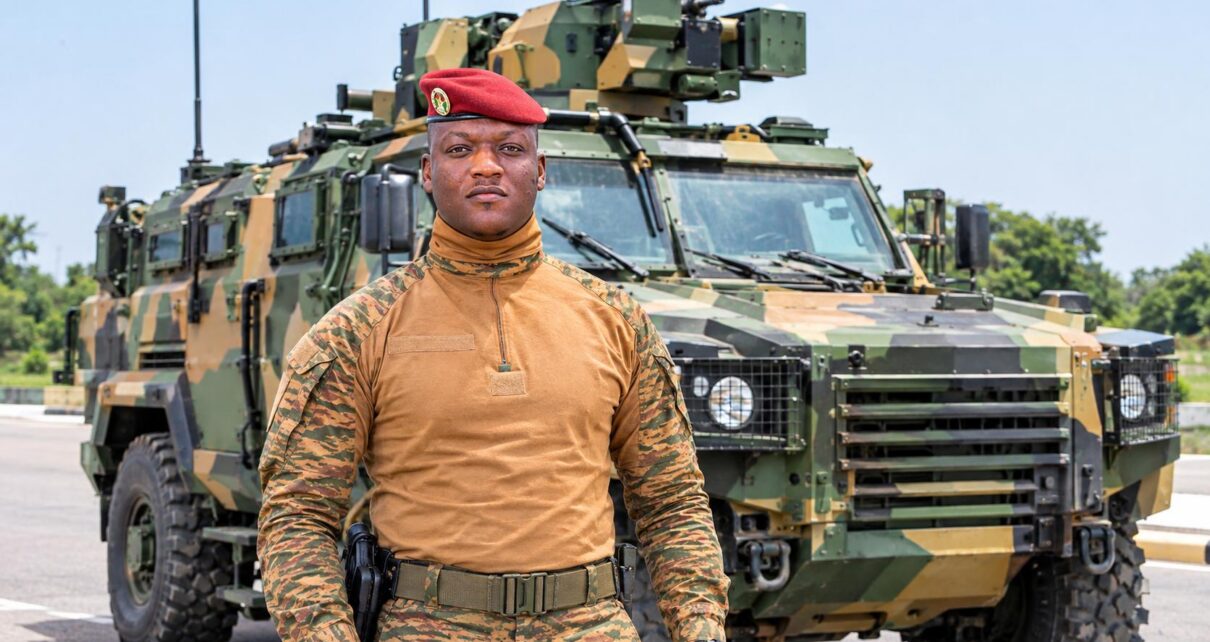
Nearly 300 armored vehicles bearing the name “Nanga” — scorpion — are said to have been built or converted inside Burkina Faso since November 2025. Captain Ibrahim Traoré, head of the Transition, has presented the state-owned or mixed-capital company Faso Armored as the driving force behind the country’s military self-reliance. The trouble is that no citizen, journalist or parliamentarian has ever set foot inside the plant, the assembly lines remain classified, and “national defense secrecy” is invoked to block every attempt at verification. For ordinary Burkinabè, the consequences are not abstract: money that could have funded schools, roads and clinics has already been committed, while soldiers and Volunteers for the Defense of the Homeland (VDP) ride into combat in machines whose protection has never been certified.
An announcement of triumph, and a bill that reaches every household
The promise of a home-grown armored force was widely framed as a historic leap forward. Yet the practical fallout is already being felt far beyond the barracks. Tens of billions of CFA francs have been channeled into military equipment orders without a single public tender, without a published cost breakdown and without a review by the Court of Accounts. That money does not come from nowhere. It comes from a national budget that is already stretched thin by a decade of conflict, and every franc diverted into opaque procurement is a franc taken away from the services that keep families afloat.
Why a hidden factory becomes a problem for the whole economy
A genuinely sovereign defense industry would be a heavyweight asset: skilled jobs, local supply chains, technology transfers and tax revenue. Instead, keeping Faso Armored in total darkness produces the opposite effect. There is no verifiable industrial base to boast about, no audited contract to reassure international partners, and no credible accounting trail to attract the financing the country needs. Investors, lenders and even friendly governments read opacity as risk, and risk is expensive. What looks like a patriotic victory lap quietly raises the cost of doing business with Burkina Faso.
From pickup truck to “combat vehicle”: what the front actually receives
Building an armored vehicle is not a matter of welding steel plates onto a commercial frame. It requires specialized foundries, certified ballistic steel, reinforced powertrains and heavy precision engineering. According to military sector analysts, several of the machines badged “Nanga” would in reality be ordinary utility vehicles — mostly modified Toyota chassis — bought cheaply from third countries and hastily reinforced in artisanal workshops.
Rebadged commercial chassis, not armored hulls
If that assessment holds, then what was presented as a national manufacturing breakthrough is closer to a cosmetic operation: imported civilian platforms dressed up as military hardware, with the label changed rather than the engineering.
300 Units in ten months: an industrial impossibility
Claiming the production of 300 armored vehicles in under a year, with no pre-existing industrial infrastructure, defies technical logic. Weapons manufacturers operating fully automated plants take years to deliver comparable series. A country building its first assembly capacity from scratch does not compress that timeline by a factor of ten.
What the secrecy argument shields from public scrutiny
Total confidentiality around a national industrial achievement makes little sense if the achievement is real. A guided media tour, even a partial one, would have served the narrative far better than silence. The hidden-factory formula instead protects three things:
- No budgetary oversight. Equipment orders worth tens of billions of CFA francs escape public tendering and any review by the Court of Accounts.
- No visibility on real costs and origins. Intermediate suppliers and the commissions skimmed along the way stay out of sight.
- No ballistic certification. Not a single resistance test against the STANAG standards for mines or improvised explosive devices has been published — a gap that directly exposes the men sent to the front.
On the battlefield, unproven armor means real casualties
This is where secrecy stops being a bureaucratic habit and becomes a matter of life and death. A vehicle that fails against a mine or an IED does not fail in a press release; it fails with soldiers and VDP fighters inside. If the hulls have never been tested to recognized protection norms, the people who depend on them are effectively riding in prototypes with no data attached. Their families, in turn, absorb the consequences: lost income, orphaned children, and a long-term social cost that no sovereignty slogan can offset.
Symbolic wins versus a deteriorating security reality
The Nanga announcement landed in a tense political climate where symbolic victories matter. After the lavish launch of military textile complexes such as TEXFORCES-BF, the narrative of “total independence” demanded a spectacular step up into heavy weaponry. But symbolism does not patrol roads or hold territory. Insecurity has continued to worsen across several regions, showing that a steady stream of revolutionary equipment announcements cannot compensate for deep strategic and logistical shortfalls within the armed forces.
An economic and human bill that will outlive the headlines
By elevating financial and industrial opacity into a method of governance under the cover of defense secrecy, the authorities are steering into dangerous territory. Between large-scale mechanical improvisation on one side and a self-declared industrial sovereignty on the other, the true invoice — paid in public money, in lost development opportunities and in the safety of those sent to fight — is landing squarely on the Burkinabè people. That is the consequence no communication campaign can make disappear.