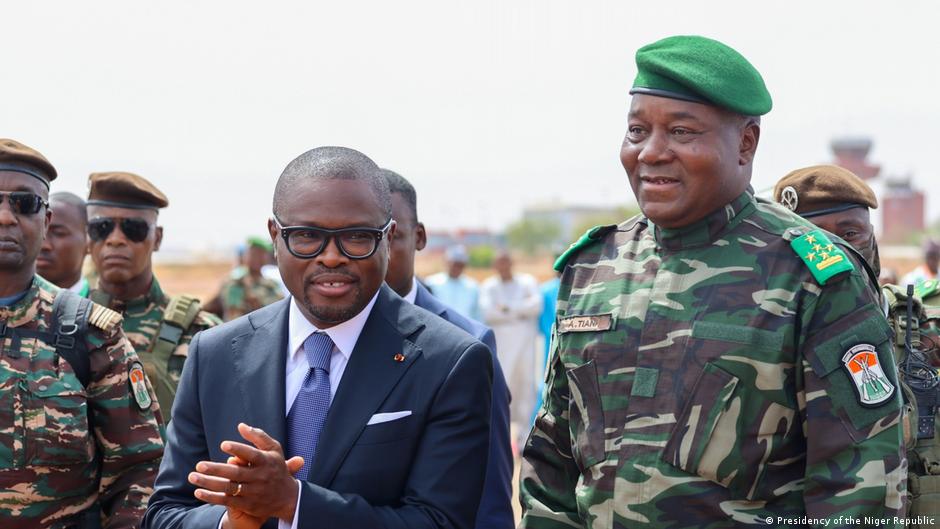
Benin-Niger border thaw: experts see light at the end of the tunnel
A joint expert committee charged with studying the reopening of the Benin-Niger border has delivered its findings. An agreement has been reached on security protocols, transit terms, and certain legal and economic aspects. However, Niger has set three non-negotiable conditions that could delay political ratification of the deal.
What future lies ahead for this three-year crisis, which has taken a severe toll on both economies and populations?
Three “non-negotiable” prerequisites
Nigerian authorities have laid out three conditions deemed essential for a sustainable border reopening, closed since 2023.
- First, the Niamey delegation demands a formal defense and security pact with Benin, ensuring mutual non-aggression and a commitment from both nations not to allow their territories to be used as staging grounds for destabilization efforts against the other.
For analyst Régis Hounkpè, executive director of InterGlobe Conseils, this commitment is self-evident: “Yes, the agreement stipulates that Benin will not attack Niger, just as Niger will not attack Benin. This is standard practice, but given the three-year freeze in relations, it feels extraordinary. The real challenge now is implementation. Both nations must ensure this clause—primarily symbolic—is respected.”
- The second condition focuses on intelligence-sharing, with the establishment of a joint cell for real-time information exchange, particularly on terrorism and cross-border trafficking.
Hounkpè praises this initiative, emphasizing its mutual benefit: “This joint cell is crucial. Both Benin and Niger must be certain no destabilization efforts are brewing on either side.”
- The third prerequisite demands full transparency regarding foreign military presence or deployments along the border, particularly on the Beninese side.
“This touches on sovereignty,” Hounkè notes. “President Wadagni has repeatedly stated that as a sovereign nation, Benin is free to pursue any military partnerships. Whether with France, China, Russia, Turkey, or an African ally—what matters is that Benin does not use these partnerships to undermine Niger’s security.” He adds: “From a pragmatic standpoint, no nation benefits from igniting conflicts beyond its borders.”
These demands reflect Niamey’s efforts to safeguard its sovereignty and territorial integrity amid deep-seated political mistrust, stemming from the military coups that brought both governments to power in mid-2023.
The high cost of a closed border for Niger…
Until Benin meets these prerequisites, the border remains closed. Yet this blockade cripples a vital trade corridor for both nations.
Niger, a landlocked country, relies on Benin as its primary maritime gateway—nearly 70% of its imports pass through this route. The port of Cotonou is equally critical for other Economic Community of West African States (ECOWAS) nations like Mali and Burkina Faso, which use Benin to source construction materials, fuel, and staple foods such as rice.
Alternate routes around Benin are longer, riskier, and have driven up logistics costs by 30-50% in less than three years. The suspension of crude oil flows through the 2,000 km Agadem-Sèmè-Kpodji pipeline—due to tensions—has cost Niger millions in lost revenue, as the pipeline was designed to export around 90,000 barrels daily.
…and the strain on Benin
Benin, too, suffers from the closure. The port of Cotonou, a key regional hub, faces severe congestion as containers pile up, disrupting supply chains and halving revenue in sectors like customs, road transport, and logistics. Businesses have cut jobs, and traders report a 50% drop in foot traffic at border markets like Malanville and Gaya.
With trade rerouted to Togo and Nigeria, Benin risks losing its status as the region’s premier transit hub. The economic fallout extends to consumers, with shortages of essential goods and soaring prices across local markets.
A mutual economic imperative
Régis Hounkpè, executive director of InterGlobe Conseils, underscores the macroeconomic benefits of reopening the border: “A reopened border would restore trade flows and revive Cotonou’s port, which has struggled for three years. It would benefit transporters, logistics firms, Nigerian businesspeople, and traders alike—restoring access to Benin’s coastal advantage.”
Human toll of the closure
The crisis has devastated local communities. Vendors at border markets report a 50% drop in customers, while many shops have shut down. Rising transport costs and rerouted trade have led to shortages and price surges for basic goods. Families have been separated, vulnerable groups face worsening poverty, and communities are cut off—fueling smuggling and extortion networks.
Economic imperatives have driven the two nations back to the negotiating table. Beninese President Romuald Wadagni, inaugurated in early June, made a landmark visit to Niamey on June 2, 2026, kickstarting the expert committee’s work.
Hounkpè believes both leaders must prioritize pragmatism over ideology: “They are bound by geography. Cooperation is not optional—it’s a necessity for economic survival, logistics, security, and counterterrorism efforts.”
The most likely outcome is a gradual reopening, with strict controls on high-priority goods. If negotiations succeed, the deal could set a positive example for the Alliance of Sahel States (AES) and ECOWAS—mirroring the recent economic-driven thaw between Mali and Côte d’Ivoire.