On June 22 in New Delhi, Morocco and India expanded their counterterrorism cooperation to include clandestine financial networks, the misuse of technology by criminal groups, and the links between transnational organizations and armed factions. The second joint working group meeting between the two nations established a shared framework built on intelligence sharing, institutional capacity-building, and alignment within key multilateral platforms.
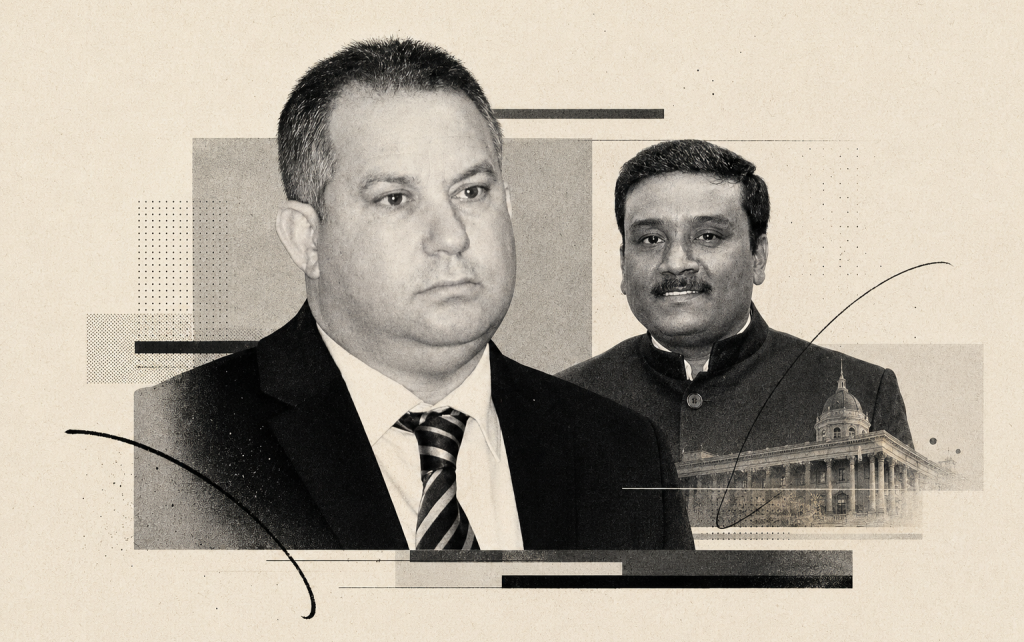
The session was co-chaired by Vinod Bahade, Joint Secretary for Counterterrorism at India’s Ministry of External Affairs, and Hicham Baali, Head of the National Brigade of the Judicial Police (BNPJ) under the General Directorate of National Security (DGSN). Discussions centered on regional threats as well as the global spread of extremist ideologies, illicit funds, technical tools, and terrorist operatives.
Both delegations issued a joint statement condemning terrorism in all its forms, including cross-border threats. They also denounced the April 22, 2025 attack in Pahalgam, Jammu and Kashmir, and the November 10, 2025 incident near New Delhi’s Red Fort.
tackling terrorist financing, radicalization and tech-enabled threats
Key topics included violent extremism, recruitment patterns, terrorist financing, and the exploitation of technology for criminal purposes. The communiqué framed these exchanges as a joint assessment of current and emerging challenges, requiring deeper analysis of recruitment channels, financial flows, communication pathways, and the digital infrastructure used by clandestine networks.
A major focus was placed on how technology fuels terrorism—covering encrypted communications, online propaganda, illicit fund transfers, and tools that enable attack planning. While no specific systems were named, the discussion linked this effort to broader collaboration on actionable intelligence, prevention strategies, and judicial responses.
The two countries also analyzed the convergence of transnational organized crime and terrorism, a relationship that spans funding streams, logistics networks, forged documents, smuggling routes, and cross-border movement of fighters and matériel. Both sides agreed to refine their joint threat assessments to better track these flows and improve information exchange.
building bilateral and global counterterrorism frameworks
Morocco and India reaffirmed their commitment to strengthening bilateral counterterrorism cooperation through information exchange, skills development, and best practice sharing. This includes leveraging police expertise, threat analysis, specialized training, and comparative policy reviews between the two nations.
The delegations renewed their pledge to advance joint action within the United Nations, the Financial Action Task Force (FATF), and the Global Counterterrorism Forum (GCTF). These bodies were highlighted as central to setting financial standards, countering violent extremism, facilitating judicial cooperation, and fostering state-to-state experience sharing.
A third joint working group meeting will be held in Morocco at a mutually agreed date, building on the New Delhi outcomes and translating them into tighter bilateral mechanisms for addressing regional and global threats.