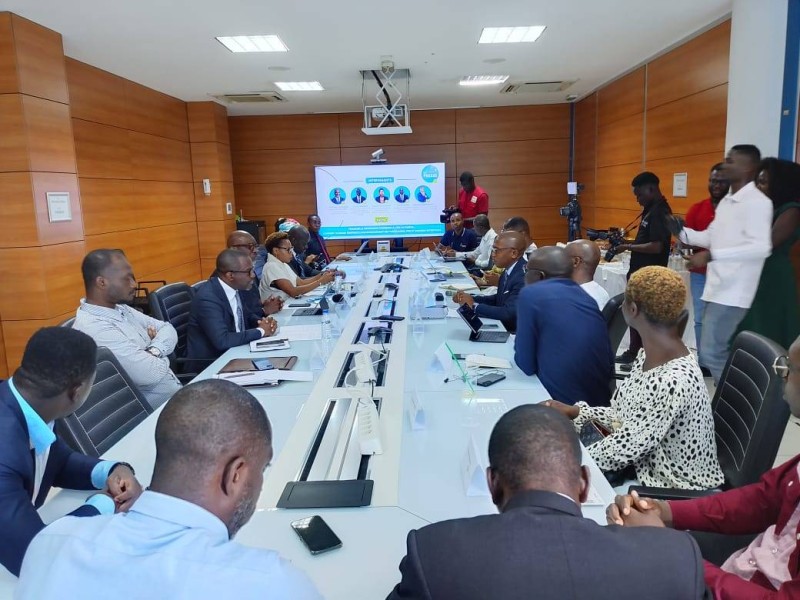
The industrialisation of Côte d’Ivoire has emerged as a critical conversation following a high-level press breakfast held in Abidjan-Plateau on May 8, 2026. Paul-Harry Aithnard, Regional Director of UEMOA and CEO of Ecobank Côte d’Ivoire, delivered a compelling argument for accelerated industrial development, positioning it as the only pathway to transform the nation into a fully emergent economy.
from emerging to emergent: the power of industrialisation
According to Aithnard, industrialisation isn’t just beneficial—it’s essential. He drew a powerful comparison with Malaysia, a country that, 25 years ago, had a GDP equivalent to Côte d’Ivoire’s current $100 billion. Yet over the past two and a half decades, Malaysia’s GDP has quadrupled to over $400 billion. Côte d’Ivoire now faces a pivotal choice: embrace industrialisation today, or risk falling further behind.
building blocks for industrial growth: finance, infrastructure, and education
Aithnard outlined a multi-pronged strategy to fast-track industrialisation in Côte d’Ivoire. At its core is financial inclusion. Expanding digital banking and mobile money services is crucial—not only to help citizens save, pay, and invest, but also to mobilise small-scale savings into productive capital. Digitalisation is the engine driving this transformation, enabling businesses to scale efficiently and reduce operational costs.
The private sector, particularly the banking industry, has a vital role to play. Aithnard called for greater private investment in large-scale infrastructure projects, stating, “We’ve made a deliberate choice to finance infrastructure—because without it, industrialisation cannot happen.”
He also underscored the need for public sector leadership. A robust, reliable electricity supply is non-negotiable for industrial growth. Additionally, the education system must be reoriented toward science, technology, and modern management practices. While Aithnard praised Côte d’Ivoire’s recent strides in energy production—doubling output in recent years—he stressed that educational reform remains a work in progress.
a shared vision for the future
This industrial vision requires collaboration across government, private enterprise, and financial institutions. By combining policy support, private capital, and technological innovation, Côte d’Ivoire can achieve the scale and productivity needed to quadruple its economy within a generation. The message is clear: industrialisation is not optional—it is the foundation of sustainable economic development.