Libreville, Wednesday 24 June 2026 – For years known as an exporter of oil, manganese and raw timber, Gabon is now seeking to redefine its economic identity.
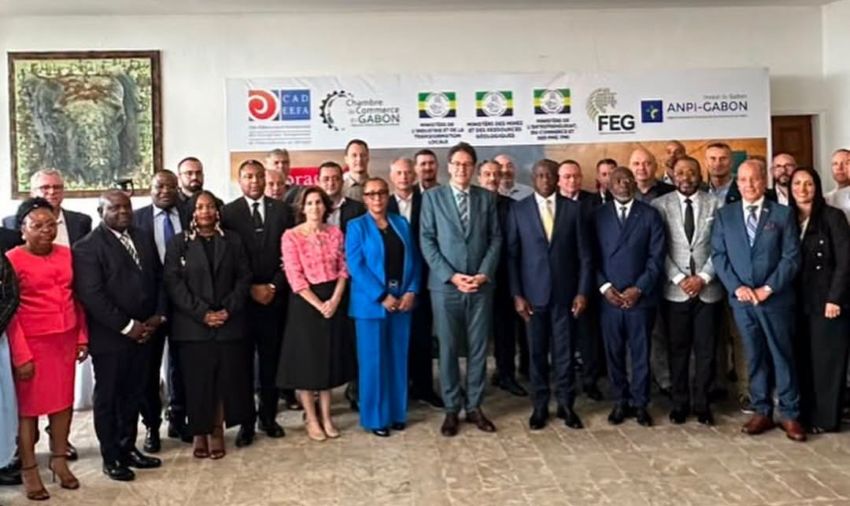
The opening of the Gabon Industry Meetings on Tuesday in Libreville, under the authority of Vice-President Hermann Immongault, marks another step in a national strategy that aims to make local processing of natural resources the driving force for the next phase of economic development.
Beyond speeches and intentions, the gathering carries particular weight. By bringing together around twenty European investors, public officials, industrialists and international partners, Libreville is trying to send a strong signal to markets. Gabon no longer wants to be merely a supplier of raw materials. It aspires to become a hub of production, processing and value creation.
This ambition places the country at the heart of a debate now sweeping across Africa: how to transform abundant natural resources into genuine industrial power?
The time for economic transformation
Hermann Immongault’s message is unambiguous. For him, industrialisation is no longer an option but a strategic necessity for the nation’s future.
This statement reflects a realisation widely shared among commodity-dependent African economies. For decades, producing countries have exported raw resources only to re-import processed, high-value goods. This logic severely limits local economic benefits and hinders the creation of skilled jobs.
Yet Gabon possesses considerable assets. Its mineral reserves are among the largest in Central Africa. Its forestry potential is recognised globally. Its energy sector remains a pillar of the regional economy.
For the authorities, the real challenge now is to transform these natural advantages into industrial value chains capable of generating more wealth within the national territory.
In this context, the High Investment Council has begun a thorough review of the main obstacles stifling productive investment. The authorities are now promising concrete measures to strengthen legal certainty, improve the business climate and facilitate the establishment of new industrial units.
Attracting capital to build a national industry
Minister of Industry Lubin Ntoumtoume presented a roadmap based on several key pillars: modernising the regulatory framework, simplifying administrative procedures, improving access to energy, strengthening logistics infrastructure and developing local skills.
This strategy comes amid a global context marked by the reorganisation of international supply chains. Many investors are now seeking new industrial platforms capable of producing closer to emerging markets.
Gabon hopes to capitalise on this shift. The presence of European investors at these meetings signals growing interest in the Gabonese market. France’s ambassador to Gabon, Fabrice Mauriès, emphasised the need to build an economic relationship based on co-development rather than the traditional extraction model.
This direction is also championed by event organisers, who aim to bring together the state, businesses and training centres to create a coherent industrial ecosystem.
Modern industry no longer rests solely on infrastructure. It also depends on the quality of human capital, innovation and the ability of education systems to meet market needs.
The decisive test: turning words into action
The Gabon Industry Meetings come at a turning point for the country. In recent years, Gabon has implemented multiple reforms to reduce its dependence on raw material exports.
Local timber processing is often cited as a successful example. The ban on log exports has fostered a processing industry that generates more added value and jobs. The authorities now want to replicate this dynamic in other strategic sectors, notably mining, metallurgy, agro-industry and service industries.
Planned visits to Port-Gentil, Moanda and Greater Libreville illustrate the desire to show investors existing infrastructure and ongoing projects. But the success of this strategy will depend less on announcements than on execution. Africa has seen many ambitious industrial plans founder on administrative, logistical or financial realities.
The real challenge for Gabon is therefore to demonstrate its ability to turn its industrial vision into concrete achievements.
The opening of these meetings is thus more than a simple economic event. It represents a credibility test for a country seeking to redefine its place in the global economy. If this strategy succeeds, Gabon could become one of Africa’s most advanced laboratories for industrial transformation of natural resources.
If it fails, it will remain stuck with the same equation that has held back many resource-rich economies for decades.