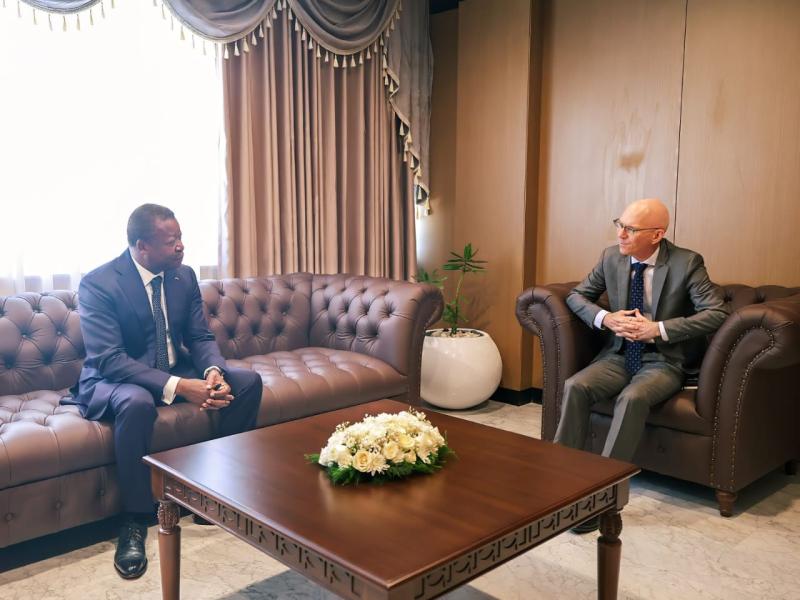
On Monday, June 8, 2026, in Lomé, Togolese Council President Faure Essozimna Gnassingbé, who serves as the African Union mediator, welcomed United Nations Special Representative for the Democratic Republic of the Congo (DRC) and MONUSCO head James Swan, alongside UN Special Envoy for the Great Lakes Region Huang Xia.
According to the Togolese presidency, discussions focused on the progress of ongoing diplomatic initiatives and the UN’s contribution to African Union-led mediation efforts aimed at a lasting resolution to the crisis in eastern DRC.
Both UN officials, deeply engaged in peace and stabilization work in eastern DRC and the Great Lakes region, are in Lomé for the semi-annual evaluation meeting of the African Union mediation in this part of the continent.
“The UN representatives praised Togo’s commitment to promoting peace, stability, and peaceful conflict resolution on the African continent. They expressed their readiness to support the Council President, the designated African Union mediator, in finding a fair and lasting solution to the crisis affecting this region.”
Appointed as the African Union mediator for the eastern DRC crisis, replacing Angolan President João Lourenço, Faure Essozimna Gnassingbé has intensified consultations with the United Nations over recent months to foster a coordinated approach to peace in the Great Lakes region.
James Swan’s presence in Lomé is particularly significant. Having taken office nearly two months ago, this marks his first participation in the semi-annual evaluation meeting of peace initiatives under the African mediation led by Togo.
This meeting comes amid a backdrop where, despite the Washington Agreement and a series of assessment meetings, the security and humanitarian situation in eastern DRC continues to deteriorate. The decline persists even as diplomatic initiatives multiply in an attempt to resolve the crisis.
The erosion of trust between the parties and the lack of political will among certain regional actors, which hampers the effective implementation of commitments, remain major challenges for mediators, particularly the United States and Qatar. These parties are urged to continue their efforts toward a resolution of the current security crisis, marked by the AFC/M23 rebellion, which Kinshasa accuses Rwanda of supporting.
In response, voices at national, regional, and international levels continue to call on the various protagonists to respect commitments made under peace initiatives. However, these appeals have so far had little effect. The goal of bridging the persistent gap between ground realities and diplomatic progress on paper remains elusive. Each party continues to interpret the agreement’s provisions in its own way, making implementation increasingly hypothetical.
The same applies to the Doha process, under the auspices of Qatar. Despite several rounds of talks, Kinshasa and the AFC/M23 rebellion still struggle to align their positions on key differences. The Montreux stage in Switzerland, intended to inject new momentum into the process, did not yield the expected results. Commitments from that negotiation phase have not been fully honored, and the deteriorating security situation in the Middle East has also pushed this matter to the background, further slowing mediation efforts.