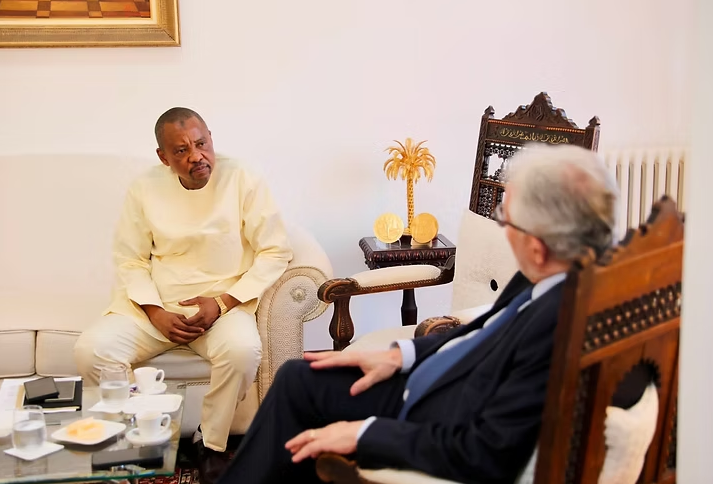
In an unprecedented move, the Nigerien chargé d’affaires in France, Hamadou Saley, was recently received by Chems-eddine Hafiz, rector of the Grand Mosquée de Paris. Behind the announced cultural or religious collaboration projects, a more subtle political maneuver appears: Niamey’s attempt to bypass the Quai d’Orsay and rebuild ties with Paris through France’s Muslim community, after diplomatic doors were slammed shut.
Bypassing traditional diplomacy
Following the political upheavals in Niamey and the sharp deterioration of Niger-France relations, official communication channels have ground to a halt. Diplomatic expulsions, anti-French rhetoric, and the termination of cooperation agreements have frozen the Paris-Niamey axis. Yet, economic, migration, and geopolitical realities often override even the most radical positions. The Nigerien government knows it cannot afford to sever all ties with France—but with traditional diplomacy blocked, what alternatives remain?
This is where shadow diplomacy, and specifically faith-based diplomacy, comes into play. By sending its chargé d’affaires to one of France’s most symbolically powerful religious institutions, Niamey is attempting a tactical shift. Denied high-level meetings at the French Foreign Ministry, the Nigerien representative seeks an audience and legitimacy within a cornerstone of France’s Muslim community.
Religion as a political tool
This approach is far from a mere act of religious courtesy. Leveraging faith-based channels to convey messages or test political waters is a deliberate strategy to circumvent institutional boycotts. The Grand Mosquée de Paris, with its deep-rooted ties to the French state, offers a unique entry point. For Niger, this means slipping in through the back door of France’s public and political space after being locked out of the front.
This maneuver, however, raises serious questions about consistency. While Niamey’s official discourse condemns foreign interference and calls for a complete break with its former partner, its behind-the-scenes diplomacy is actively exploiting religious structures in France to soften its image and restore indirect dialogue.
The limits of diplomatic subterfuge
Cultural and religious initiatives should not serve as a smokescreen for covert political normalization. If Niger truly seeks to rebuild constructive relations with France, it must do so openly, through official state channels and international protocols—not by exploiting the religious sensitivities of a third country.