Senegal’s effort to place special funds under genuine parliamentary oversight has run aground, and the fallout reaches well beyond the corridors of the National Assembly. For as long as the reform stays unfinished, a substantial slice of the state’s discretionary spending keeps circulating with no external accounting check. The consequence is tangible: money that should be arbitrated between security, health, education or support for struggling businesses is instead committed without any verifiable public debate.
What the deadlock costs households, companies and the treasury
The effects on ordinary life are indirect, but they are real. When billions of CFA francs sit outside independent verification, the fiscal room available for public services and investment narrows, and the credibility of budget discipline weakens. Businesses that deal with the state, or that simply plan on the basis of published budget figures, are left working with numbers nobody can confirm. Citizens, meanwhile, have no way of measuring what is spent on their behalf, or of comparing it with what is announced.
A reform file opened in haste, then brought to a halt
Deputies had started the work with visible energy. On 10 August 2026, meeting in an extraordinary session, they examined on an urgent basis a bill setting out the legal regime for special credits, carried in particular by deputy Guy Marius Sagna. The ambition was to break the long-standing opacity surrounding funds traditionally lodged at the Presidency and the Prime Ministry. The text provided for:
- a strict legal framework governing the creation and use of special credits;
- a confidential audit mechanism entrusted to a parliamentary commission;
- the participation of magistrates from the Court of Auditors in that verification.
The executive’s counter-proposal
Resistance surfaced by mid-August. On 13 August, Justice Minister Moussa Sarr tabled a government amendment seeking to reduce the text to general principles, leaving the precise arrangements for execution and oversight to regulatory power, and therefore to the executive itself, on the basis of articles 67 and 76 of the Constitution.
A widening of scope, a vote, then a freeze
A further amendment filed on 14 August proposed explicitly to bring the Presidency, the National Assembly and the Prime Ministry within the reform’s field of application. The signal was clear: the controversy concerned less the principle of stronger oversight than the level of norm used to deliver it, and the exact extent of the parliamentary control to be created. The text was passed on 19 August, only for its examination to be suspended the very next day after the executive lodged an appeal.
The constitutional ruling that sent deputies back to the drawing board
The appeal produced its effect. On 25 August 2026, the Constitutional Council rejected the ordinary bill outright, holding that the regime governing public credits falls exclusively within the domain of an organic law and cannot be introduced through an ordinary law passed on a simple parliamentary initiative. Deputies were forced to restart the whole process on a different legal foundation. On 2 September 2026, the Bureau of the National Assembly declared admissible a fresh organic bill, this time amending organic law no. 2020-07 of 26 February 2020 on finance laws. Under the institution’s rules of procedure, the President of the Republic must now be consulted for an opinion before the text returns to committee and is placed on the agenda, a procedural step that pushes any operational oversight mechanism further into the future.
A ceiling frozen since 2011 while actual spending drifts
The financial stakes are as poorly mapped as the legal ones. Since 2011, the amount allocated to special funds in the initial finance law has been renewed unchanged at 8,856,296,000 CFA francs, even though the sums ultimately mobilised during the year diverge from that figure on a recurring basis. No independent verification mechanism currently exists that could account for the difference precisely.
Two consequences follow. The published figure carries little predictive value, since it says nothing about what will actually be spent. And because the gaps are never publicly reconciled, neither the National Assembly nor the public can gauge the true weight of these expenditures against the rest of the budget.
Confidentiality is not the target, the perimeter is
National defence secrecy has been preserved in every version of the text examined so far. The stated aim was never to abolish the confidentiality attached to sovereign spending, but to replace a total absence of oversight with a bounded form of control, exercised by bodies cleared to handle classified material without disclosing it. What remains unresolved is whether that control will extend as far as the funds held not only at the Presidency but also at the Prime Ministry and, potentially, at the National Assembly itself. Some observers doubt that deputies would accept seeing their own credits subjected to the same degree of scrutiny as those of the executive.
Two competing visions of what special funds are for
The institutional debate has also laid bare a deeper disagreement. The parliamentary majority wants these funds confined strictly to sovereign, regalian functions, while the executive defends their use in responding to humanitarian and social emergencies. The friction centres on how the perimeter and the purposes of the funds are defined, and on how control should be organised.
Until the organic text clears parliament, the spending stays unverified
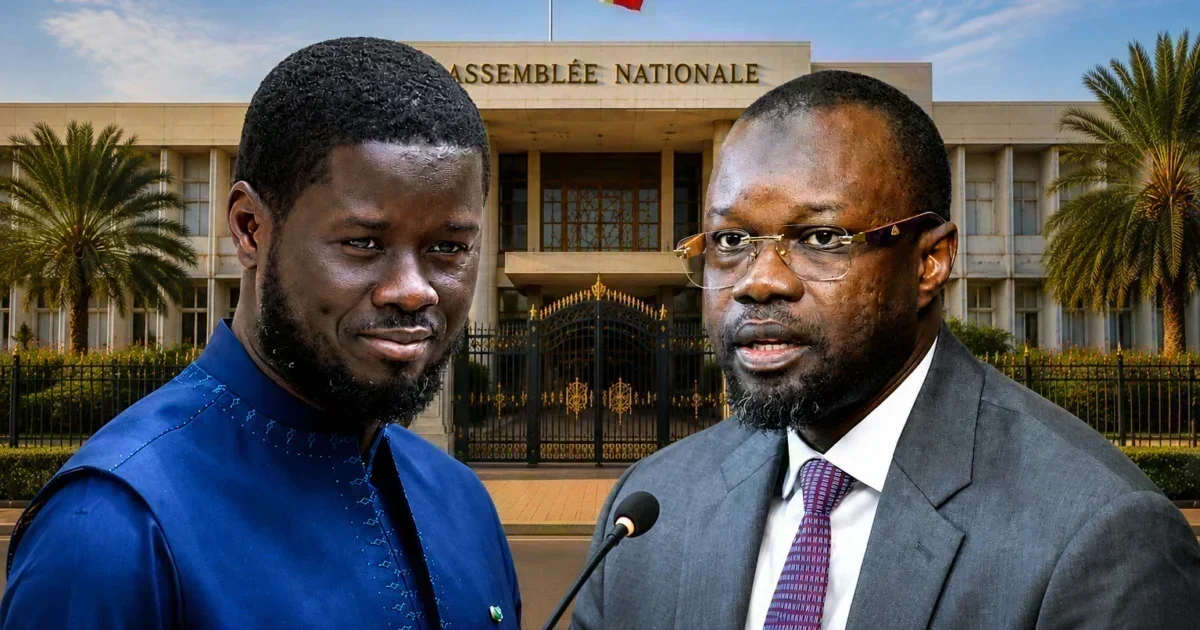
That is the crux for citizens, businesses and the public accounts alike: unless the organic bill completes its parliamentary journey, the entire set of expenditures, from the Presidency to the Prime Ministry and possibly the National Assembly, remains outside fully operational parliamentary oversight, despite the offensive launched by Ousmane Sonko and his fellow deputies since the beginning of August.